
Government spending has stagnated since covid
Budgets are not keeping up with the growth in the population
 Add GroundUp on Google
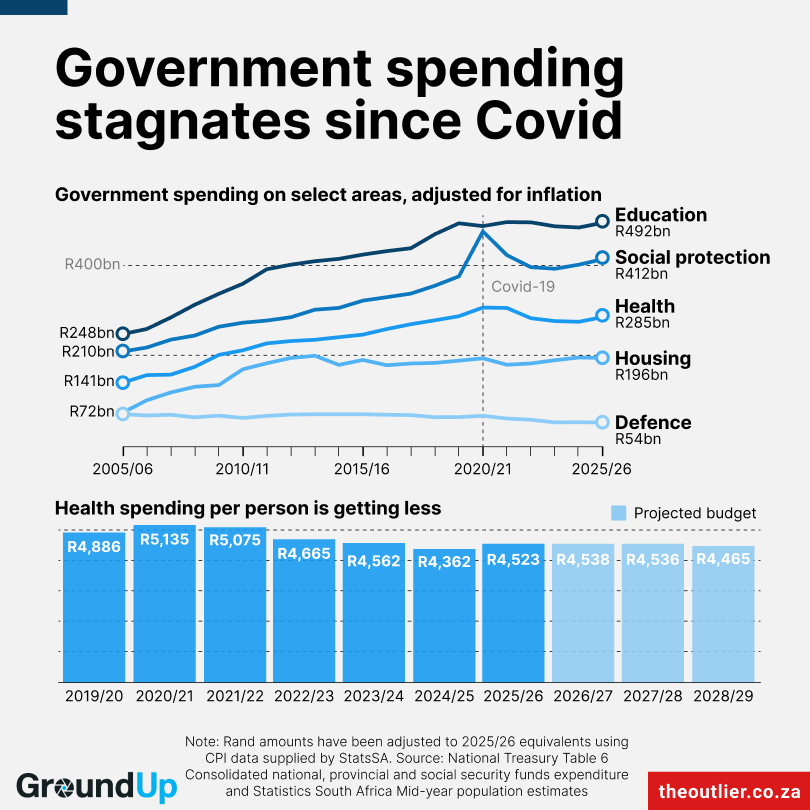
We did the math: government’s spending on essential social services has barely recovered since the covid pandemic, and for some services, it is not keeping up with population growth.
We adjusted for inflation the government’s spending on education, social protection (mostly social grants), health, housing and defence, over the past 20 years. Here’s what we found:
- Defence: spending on the army has slowly decreased from the 2025/26 equivalent of R72bn in 2005, to R54bn in 2025.
- Housing: spending on human settlements increased significantly between 2005 and 2013 — from the equivalent of R75bn to R200bn. But then it stagnated and even decreased in some years. R196bn was spent on housing in 2025.
- Health: Until the covid pandemic, spending on health was increasing every year - from the equivalent of R141bn in 2005 to R306bn in 2020. But after covid, the budget was cut, dropping to R274bn in 2024. In 2025, the health budget was R285bn.
- Social protection: The number of people on social grants has increased over the years, and this caused the budget to rise from the equivalent of R210bn to a peak of R473bn in 2020, when millions of people lost their jobs and received the R350-a-month social relief of distress grant. Social grant spending has since stabilised, with R412bn spent in 2025.
- Education: Spending on education grew fast, from the equivalent of R248bn in 2005 to R390bn in 2011. It continued to grow in subsequent years, but at a slower pace. Education spending peaked in 2019 at R491bn. Since then, there have been substantial budget cuts and spending only really started to increase again in 2025, reaching R492bn.
While education and health spending appear to have stabilised, the budgets are not keeping up with the growth in the population.
The equivalent of R4,886 was spent per person in 2019 on health. Only R4,523 was spent per person in 2025.
When using StatsSA’s estimates for population growth and the Reserve Bank’s inflation target of 3%, the amount spent on health per person for 2026-2029 will be decreasing.

The same is true of the education budget. The Institute for Economic Justice (IEJ) found that over the next three years, spending per learner will decline by 0.33% over the next three years.
Support independent journalism
Donate using Payfast

Don't miss out on the latest news
We respect your privacy, and promise we won't spam you.
© 2026 GroundUp. This article is published under the GroundUp Republication Licence Version 1.0. Email [email protected] to request permission to republish.